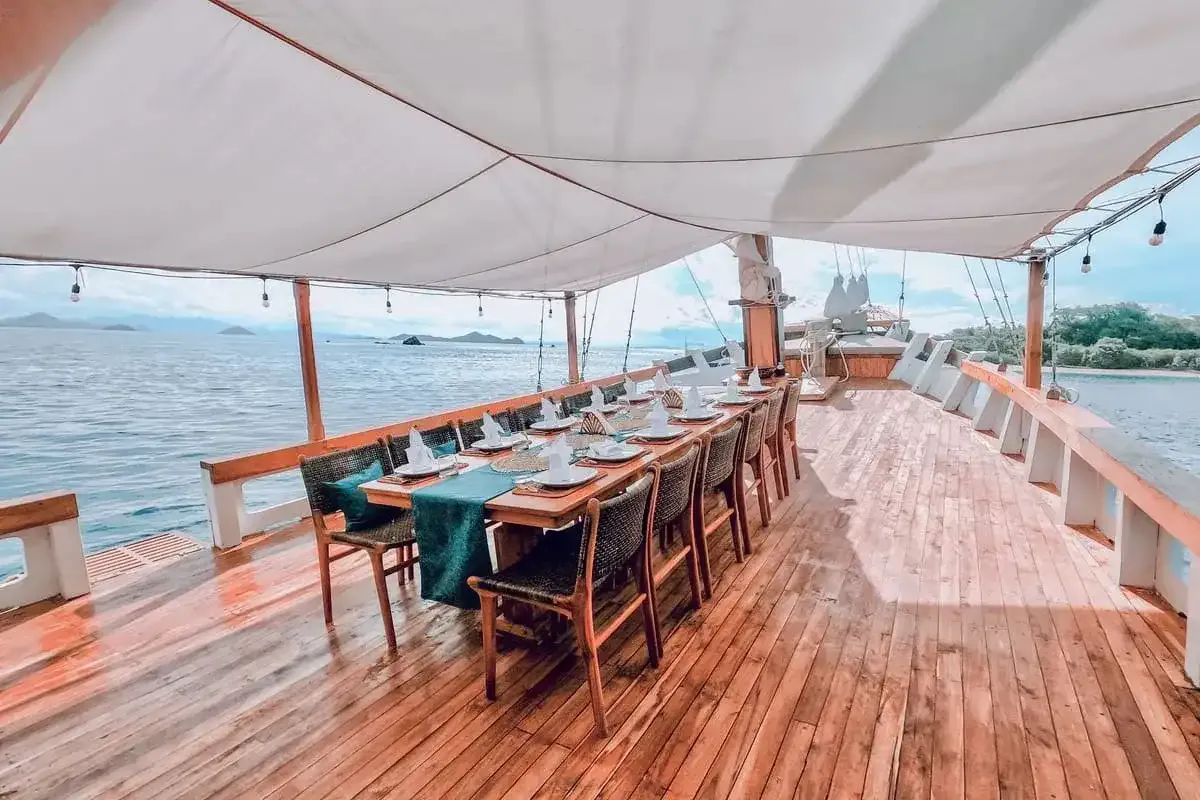
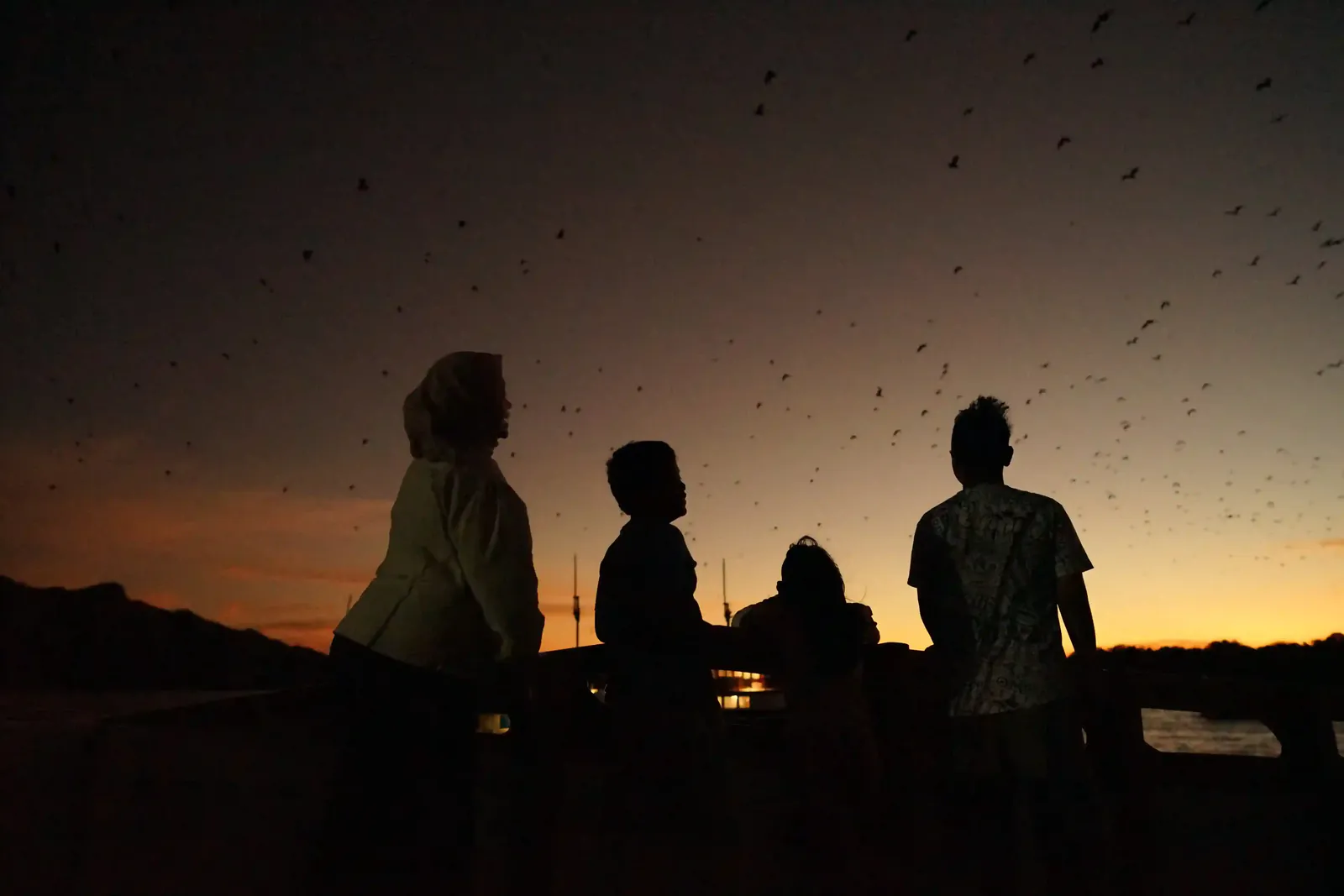
The flying foxes leave the mangroves at Kalong roughly fifteen minutes before to fifteen minutes after sunset, in a stream that lasts about half an hour. Liveaboards anchor there for the night because it is both the day’s best hour and the launch point for the three-to-four-hour overnight sail to Padar. Day boats cannot stay for either.
Vessel data and rates on this page come from the operator’s published Magika rate card and specification sheet and were checked on 1 August 2026. Rates are reviewed annually and move with fuel, route changes and regulation. Ask for the current sheet in writing before you transfer a deposit.
What actually happens at Kalong?
Kalong — the name simply means flying fox in Indonesian — is a small mangrove island north-east of Rinca. Thousands of large fruit bats roost in the mangroves through the day. At dusk they leave, not all at once but in a continuous stream toward the Flores mainland to feed, and the stream passes directly over boats anchored off the mangrove line.
It is a genuinely unusual thing to watch, and it is unusual in a specific way: it is quiet. There is no engine noise because the boat is at anchor, no commentary because there is nothing to explain, and no queue because you are watching from a deck rather than a viewpoint. On a three-day itinerary built around hikes, tenders and timed landings, this is the only hour that asks nothing of you.
| Time | What happens |
|---|---|
| ≈ 16:30–17:00 | Boat arrives from Manjarite (~1 hour) and sets anchor off the mangroves |
| ≈ 17:00–17:45 | Swimming, deck time, drinks; the mangrove line is still silent |
| ≈ 17:45–18:30 | The exodus — a continuous stream of flying foxes overhead, roughly 30 minutes |
| ≈ 19:00 | Dinner at anchor in sheltered water |
| Overnight | Boat sails 3–4 hours to the Padar anchorage while guests sleep |
| ≈ 04:30 | Wake-up for the Padar sunrise hike |
Why the anchorage matters more than the bats
Here is the structural point that itinerary lists never make explicit. Kalong is not on the route because of the wildlife; it is on the route because it is the right place to be at dusk if you intend to be on Padar at first light. The bats are the bonus.
| Leg | Approximate time at 8 knots |
|---|---|
| Labuan Bajo → Kelor | ~1 hour (verified) |
| Labuan Bajo → Kanawa | ~1–1.5 hours |
| Kelor → Manjarite | ~0.5–1 hour |
| Manjarite → Kalong | ~1 hour |
| Kalong → Padar (sailed overnight) | ~3–4 hours |
| Padar → Pink Beach | ~1–1.5 hours |
| Pink Beach → Komodo Island | ~0.5–1 hour |
| Komodo → Manta Point (Karang Makassar) | ~0.5–1 hour |
| Manta Point → Taka Makassar | ~20–30 minutes |
| Taka Makassar → Siaba | ~1–1.5 hours |
| Siaba → Kanawa | ~1–1.5 hours |
Read the table as a sequence and the logic assembles itself: Labuan Bajo to Kelor is about an hour, Kelor to Manjarite another half hour to an hour, Manjarite to Kalong an hour. That lands you at the mangroves in the late afternoon of day one with the whole night available for the Padar leg. A day-trip boat that has to return to Labuan Bajo the same evening can do none of this.
Do you sleep well while the boat is sailing?
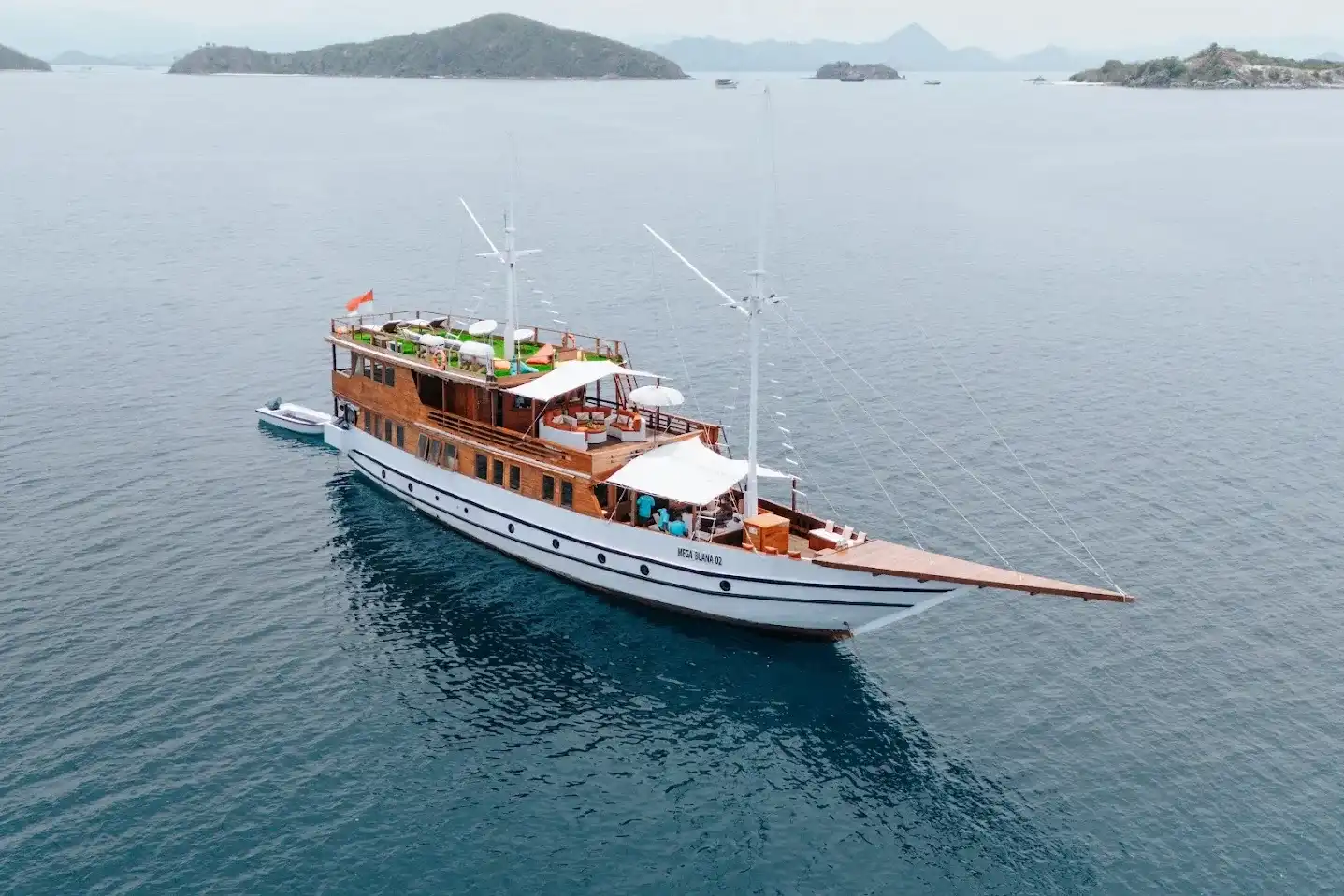
This is the honest question and it deserves an honest answer rather than a brochure line. A 26.74-metre wooden phinisi with a 6.03-metre beam sailing at eight knots is not silent, and no boat in this class carries active fin stabilisers — we say so plainly on what the hull, tenders and toys actually do. What the hull does have is mass and beam, and what the route has is timing: the Kalong-to-Padar leg is run in the small hours when the sea is typically at its most settled.
| Item | Figure |
|---|---|
| Length overall | 26.74 m |
| Beam | 6.03 m |
| Hull | Wooden phinisi — ironwood and balau |
| Cruising speed | 8 knots |
| Main engine | Mitsubishi 6D22 |
| Generators | 4D 30 KVA + 7,500 W emergency set |
| Fresh water | 5 tonnes |
| Cabins | 9, all ensuite |
| Maximum guests | 22 |
| Crew | 6 |
Cabin position matters here more than on any other night of the trip. Cabins nearer the engine hear the engine. If you are a light sleeper, this is the conversation to have at booking rather than at midnight — the layout logic is on Magika’s suites, crew ratio and 2027 rates.
What is worth photographing, and what is not
Realistic expectations save disappointment. The bats are large but they are silhouettes against a fading sky, and they are moving. Phone cameras produce a grey smear; anything with a fast lens and manual exposure produces the image people recognise.
- Shoot into the afterglow, not away from it. The stream reads as shape against light.
- Expose for the sky, let the bats go black. Trying to lift them produces noise and nothing else.
- Wide, not telephoto. The subject is the volume of the stream, not an individual animal.
- Then put the camera down. Thirty minutes is not long, and the second half is better watched than worked.
Is there anything else to do at Kalong?
Swimming off the boat before dusk, and dinner afterwards. That is intentionally the whole list. The anchorage is sheltered, which is why it is used, and the mangroves are not a landing site. Anyone hoping to walk ashore should recalibrate: this is a stop that happens from the deck.
What the galley does with an evening at anchor — and how special diets are handled when the boat is not moving — is on onboard dining and special diets. For what happens at 04:30 the next morning, see the Padar sunrise timing guide.
How to check dates and book
When you compare itineraries, look for the overnight anchorage rather than the island count. Kalong on the list at dusk is the tell that the Padar sunrise is real. Magika’s calendar is held by the reservations desk at Komodo Luxury, the operator that markets and charters the vessel — trading since 2015 and part of Juara Holding Group.
- WhatsApp: +62 811 3823 875 — quickest route to a live availability check or a date hold
- Email: [email protected] — better for written quotes, contracts and invoices
Ask for the rate sheet, the cabin allocation and the deposit ladder in one written message. Anything an operator will not put in writing is not a policy.
Frequently asked questions
What time do the bats leave Kalong Island?
Roughly fifteen minutes either side of sunset, in a continuous stream lasting about thirty minutes. Boats anchor off the mangrove line in the late afternoon and watch from the deck.
Why do Komodo liveaboards anchor at Kalong overnight?
Because it is the correct staging point for Padar. From Kalong the boat sails three to four hours through the night to the Padar anchorage, putting guests on the ridge for sunrise. The flying-fox exodus at dusk is the bonus, not the reason.
Can you go ashore at Kalong Island?
No. Kalong is a mangrove roost, not a landing site. The stop is watched from the deck, with swimming off the boat before dusk and dinner at anchor afterwards.
Does the boat sail while you sleep?
Yes, on the Kalong to Padar leg — three to four hours in the small hours, when the sea is typically most settled. A wooden phinisi has no active fin stabilisers; comfort comes from hull mass, a 6.03-metre beam and the choice of timing.
How do you photograph the flying foxes?
Shoot into the afterglow rather than away from it, expose for the sky and let the bats read as silhouettes, and go wide rather than telephoto — the subject is the volume of the stream. Phone cameras generally do not cope.